


Tuple, Set, and Dictionary
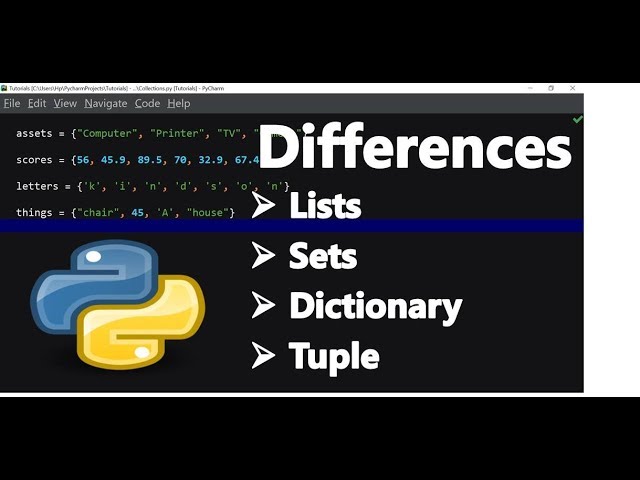
These are all fundamental data structures used to organize information in programming. Here's a breakdown of each:
Tuple:
- Ordered collection of elements, similar to a list.
- Elements can be of different data types (strings, numbers, etc.).
- Immutable: Once created, you cannot change the elements within the tuple.
- Used for representing fixed data like coordinates (x, y) or product details (name, price, stock).
Set:
- Unordered collection of unique elements.
- Elements can be various data types.
- Useful for storing unique items and performing set operations like checking membership or finding differences between sets.
Dictionary:
- Unordered collection of key-value pairs.
- Keys must be unique and immutable (often strings or numbers).
- Values can be any data type.
- Used for storing data where you need to access it by a specific key, like phone numbers in a phonebook (key: name, value: phone number).
Here's a table summarizing the key differences:
| Feature | Tuple | Set | Dictionary |
|---|---|---|---|
| Order | Ordered | Unordered | Unordered |
| Mutability | Immutable | Mutable | Mutable |
| Duplicate Data | Allowed | Not Allowed | Not Allowed (for Keys) |
| Access Method | By index | By membership | By key |

 English
 Arabic
 Spanish
 Portuguese
 Deutsch
 Turkish
 Dutch
Dutch
 Italiano
 Russian
 Romaian
 Portuguese (Brazil)
 Greek
Greek